
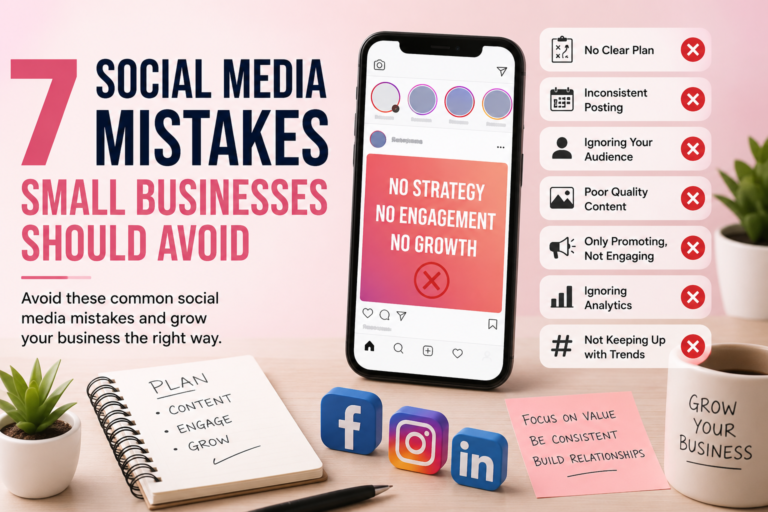
7 Social Media Mistakes Small Businesses Should Avoid
Social media can be one of the most useful marketing tools for a small business.
But simply being on Instagram, Facebook or LinkedIn does not guarantee results.
Many small businesses spend time creating posts but struggle to see meaningful engagement, enquiries or sales.
Often, the problem isn't the platform itself.
It is the way the platform is being used.
Here are seven common social media mistakes small businesses should avoid.
1. Posting Without a Strategy
One of the biggest mistakes is posting whatever comes to mind.
Monday might be a product photo.
Tuesday might be a motivational quote.
Friday might be a random promotional post.
There is nothing wrong with these individual posts, but when there is no bigger strategy, your audience may struggle to understand what your brand actually offers.
Before creating content, decide:
* Who is your target audience?
* What problem do you solve?
* What do you want people to do?
* What type of content will help them?
* What makes your business different?
A strategy gives your content direction.
2. Trying to Be Everywhere
Instagram, Facebook, LinkedIn, YouTube, TikTok, Pinterest...
It can be tempting to create an account on every platform.
But managing too many platforms can quickly become overwhelming, especially for a small business.
Current small-business social media guidance recommends focusing on the platforms where your customers actually spend time rather than trying to maintain a presence everywhere.
It is better to manage two platforms consistently than six platforms poorly.
3. Only Posting Promotional Content
Imagine following a business that posts:
*"BUY NOW!"*
*"SALE!"*
*"CONTACT US!"*
*"LIMITED OFFER!"*
Every day.
You would probably stop paying attention.Your audience needs more than promotions.Try mixing different types of content:
### Educational
Teach something useful.
### Entertaining
Create content people enjoy.
### Inspirational
Share ideas, stories or customer success.
### Behind the scenes
Show the people and process behind your business.
### Promotional
Tell people about your products or services.
A balanced content strategy gives people a reason to follow your business even when they are not ready to buy.
4. Ignoring Comments and Messages
Social media is supposed to be social.
If someone takes the time to comment on your post or send you a message, ignoring them can mean losing an opportunity.
Reply to questions.
Thank people for positive comments.
Handle complaints professionally.
Continue conversations where appropriate.
For many small businesses, direct messages can become part of the path from social media discovery to enquiry and purchase.
Your audience should feel that there is a real person behind the account.
5. Chasing Every Trend
Trends can be useful.
But not every trend is right for every business.
A trend might be popular today and forgotten next week.
Instead of copying every viral idea, ask:
*"Does this trend make sense for my brand and my audience?"*
If it does, adapt it.
If it doesn't, skip it.
In 2026, authenticity and meaningful community interaction are increasingly important, so businesses can benefit from using trends selectively rather than making their entire strategy trend-driven.
6. Measuring Only Likes and Followers
A business can have thousands of followers and still struggle to generate customers.
At the same time, a smaller account might generate regular enquiries.
That's why you should look beyond follower count.
Depending on your goals, track:
* Reach
* Engagement
* Saves
* Shares
* Profile visits
* Website clicks
* Messages
* Leads
* Sales
For example, if your goal is to generate enquiries, five genuine customer messages may be more valuable than 500 likes.
7. Giving Up Too Quickly
This is perhaps the biggest mistake.
A business posts for two weeks.
The posts don't go viral.
Then they stop.Social media marketing is not always about instant results.Building recognition and trust takes time.
You need to test different content, understand what your audience responds to and improve your strategy.
Consistency doesn't mean posting the exact same thing every day.
It means continuing to show up with useful, relevant content.
What Should Small Businesses Do Instead?
Start simple.
Step 1: Define your audience
Know who you are trying to reach.
Step 2: Choose your platforms
Focus on the platforms your audience actually uses.
Step 3: Create content categories
For example:
*40% Educational*
Tips, tutorials and information.
*30% Engagement*
Questions, opinions and interactive content.
*20% Brand-focused*
Behind the scenes, testimonials and your story.
*10% Promotional*
Products, services and offers.
These percentages don't have to be followed exactly. The important thing is creating variety.
Step 4: Create a realistic schedule
Don't create a schedule you cannot maintain.
A simple, consistent plan is better than an ambitious plan that lasts for one week.
Step 5: Review your results
Look at which posts receive meaningful engagement, clicks and enquiries.
Then create more content based on what you learn.
Conclusion
Social media isn't about posting as much as possible.
It's about creating the right content for the right audience and giving people a reason to trust and remember your business.
Avoid posting without a plan.
Don't try to be everywhere.
Don't make every post an advertisement.
Talk to your audience.
Measure meaningful results.
And most importantly, give your strategy enough time to work.
With consistency and a clear direction, social media can become a valuable part of your small business's overall marketing strategy.