
How Social Media Marketing Helps Small Businesses Grow
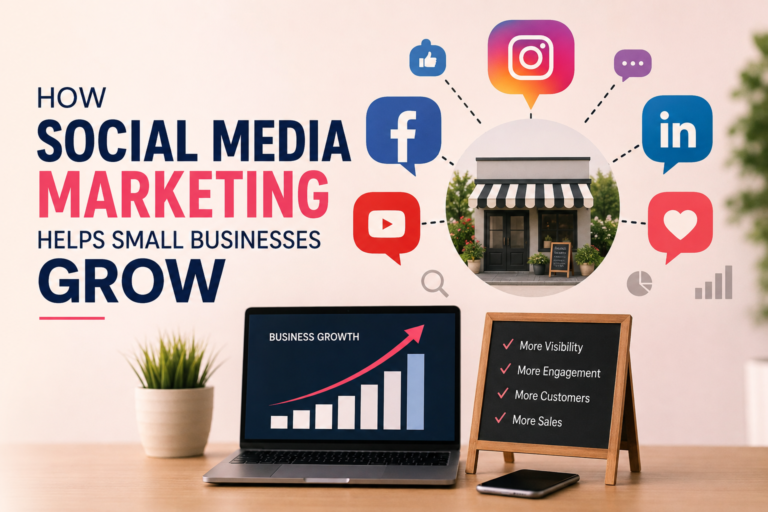
Social media has changed the way small businesses connect with their customers. Today, a business does not need a huge advertising budget to build an online presence. With the right strategy, platforms such as Instagram, Facebook, LinkedIn and YouTube can help a small business reach new people, build trust and turn followers into customers.But simply creating an account and posting occasionally is not enough. Social media works best when it is treated as part of a clear marketing strategy.
Why Is Social Media Important for Small Businesses
For many customers, social media is one of the first places they discover and learn about a business. People can see your products, understand your services, read reviews, watch your videos and even contact you directly.
Recent small-business marketing guidance highlights social media as a channel for discovery, customer feedback, engagement and measurable business growth.
For a small business, this creates an opportunity to compete with larger brands by being more personal, consistent and connected with its audience.
1. It Helps More People Discover Your BusinessThis is a title
One of the biggest advantages of social media is visibility.
A person who has never heard of your business can discover you through a Reel, post, recommendation, hashtag, search result or shared content.
For example, imagine you own a small bakery.Someone searching Instagram for birthday cakes in your area may discover one of your Reels showing a recently completed cake. They may visit your profile, look at your other work and eventually send you a message.That entire journey can begin with one piece of content.
This is why your social media content should clearly communicate:
* What your business offers
* Who you help
* What makes you different
* How people can contact you
2. It Helps Build Brand Awareness
People usually do not become customers the first time they see a business.They may see your post today, visit your profile next week and finally contact you a few weeks later.Consistent social media content keeps your business visible during that decision-making process.Your brand becomes familiar.And when someone eventually needs the product or service you provide, your business is more likely to come to mind.
3. It Builds Trust With Your Audience
People want to know who they are buying from.This is especially important for small businesses because customers often want to see the people behind the brand.
Instead of only posting promotional graphics, businesses can share:
* Behind-the-scenes content
* Customer reviews
* Testimonials
* Product demonstrations
* Educational posts
* Team introductions
* Before-and-after results
* Frequently asked questions
* Short videos
4. Social Media Creates Direct Communication
One of the biggest advantages of social media is that customers can communicate with businesses directly.They can ask questions through comments or direct messages, request information, enquire about prices and even start the buying process.For many businesses, this makes social media more than a branding platform. It can become part of the customer journey.
For example:
*Post → Profile Visit → DM → Enquiry → Customer*
This is why businesses should not ignore comments and messages.A quick, helpful response can turn someone's interest into an actual enquiry.
5. It Can Be More Affordable Than Traditional Advertising
Traditional advertising can require a significant budget.Social media gives small businesses the opportunity to start with organic content and gradually introduce paid advertising when appropriate.
Businesses can test different content, understand what their audience responds to and then invest more in campaigns that support their goals.
Paid advertising can also help businesses reach specific audiences instead of showing an advertisement to everyone.
6. Short-Form Video Can Increase Reach
Short-form video has become an important format for businesses on platforms such as Instagram, YouTube and Facebook.
Reels, Shorts and similar formats can make it easier for people to discover a business that they do not already follow. Current 2026 small-business guidance continues to emphasize short-form video, authentic content and community engagement.You don't necessarily need expensive equipment.
A simple, useful and authentic video can work well when it answers a question, demonstrates something or shows the personality behind the business.
7. You Don't Need to Be on Every Platform
A common mistake is thinking that a business needs to be active everywhere.It doesn't.The better approach is to understand where your target customers spend their time and focus your effort there.
For example:
*Instagram
Useful for visual brands, products, creators, restaurants, beauty businesses and lifestyle businesses.
*Facebook
Useful for local businesses, communities and reaching established audiences.
*LinkedIn
Useful for B2B businesses, professionals and service providers.
*YouTube
Useful for educational, demonstration and long-form video content.
The best platform depends on your audience and business goals.
8. Consistency Matters More Than Posting Randomly
Posting five times one week and then disappearing for a month makes it difficult to build momentum.Instead, create a realistic content schedule.
You could start with:
* 2–3 educational posts per week
* 1–2 short-form videos
* Regular Stories
* Customer testimonials
* Promotional content when relevant
The exact number matters less than having a system you can maintain.
9. Measure More Than Likes
Likes are not the only way to measure social media success.
Depending on your goal, you might track:
* Reach
* Profile visits
* Website clicks
* Saves
* Shares
* Comments
* Direct messages
* Leads
* Enquiries
* Sales
If your goal is to generate customers, a post with fewer likes but several genuine enquiries may be more valuable than a viral post that produces no business results.
Conclusion
Social media marketing can give small businesses something that was once much harder to achieve: the ability to communicate directly with potential customers, build a recognizable brand and create opportunities for growth without needing the resources of a large company.
The key is not to post just for the sake of posting.Have a strategy. Know your audience. Create useful content. Be consistent. Respond to people. Track your results and improve over time.
With the right approach, social media can become much more than a place to post pictures. It can become an important part of your business growth strategy.